RITA on Alibaba





Coconut water with mango juice has stepped well beyond its niche origins and onto mainstream retail shelves, and the beverage trade is paying close attention. Across the United Kingdom, buyers at supermarkets, wholesale groups and independent food and wellness retailers are looking for tropical formats that hold their flavour, travel well and need very little on-shelf explanation. One clear example of the direction the category is heading is COCO JUS Real Coconut Water with Mango Juice 500ml, produced by RITA Food and Drink Co., Ltd, a Vietnamese OEM and ODM beverage manufacturer established in 2004 that now supplies brands in more than 200 countries and territories.
The appeal of the format is not novelty but reliability. Coconut water with mango juice pairs a widely recognised tropical base with a familiar fruit character, a combination that buyers can place in both ambient and chilled sections without having to explain the product concept to shoppers. For a category defined by import logistics, that predictability matters as much as the liquid inside the bottle.
Key Takeaways
- Coconut water with mango juice is becoming a standard 500ml PET format in retail and wholesale listings across the United Kingdom.
- RITA's COCO JUS line is blended to a Brix of 7.0 ± 0.5 using real coconut water and real mango juice, with a neutral pH of 4.0 ± 0.5 for shelf stability.
- Manufacturing scale underpins trade reliability — more than 50 automated production lines and 1,200+ containers shipped monthly.
- Private label and OEM programmes let UK brands and distributors launch their own tropical juice and coconut water blends.
- An 18-month shelf life, 20–25 day delivery windows and certifications including BRC, FSSC 22000, Halal Jakim, Kosher, ISO, GMP, HACCP and SMETA support long retail cycles.
Coconut Water With Mango Juice Finds Its Place On UK Retail Shelves
Retail listings across England, Scotland, Wales and Northern Ireland tell a fairly consistent story this season. Buyers are widening the number of tropical SKUs they carry, but they are doing it selectively, favouring formats with straightforward ingredient lists, consistent fill weights and dependable replenishment. A 500ml (16.9 fl oz) PET bottle sits comfortably in that brief: large enough to read as a satisfying serve, light enough for grab-and-go shelves, and simple to merchandise alongside chilled fruit juices and coconut-based drinks.
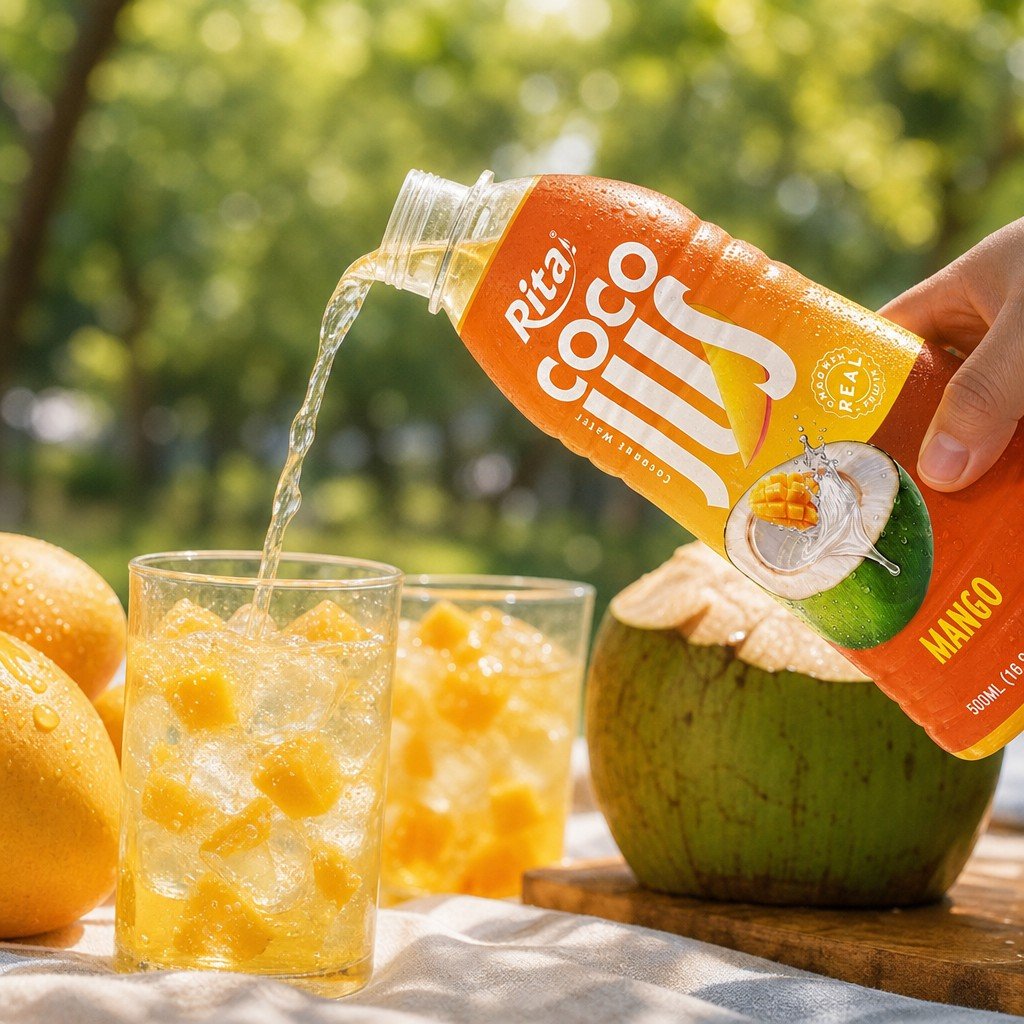
Consumer behaviour in the wider beverage aisle is reinforcing the same direction. Trade press has noted that convenience-led formats and flavour-forward launches are drawing attention away from heavily engineered drinks, while wine producers are being advised to lead with emotional storytelling rather than technical language. Elsewhere, commentators have flagged genuine headroom for beverages positioned around cleaner formulations and transparent ingredient disclosure. None of that guarantees a launch, but it does explain why a product like COCO JUS now looks like a sensible listing rather than an experiment.
What Shoppers Are Scanning For On The Shelf
The first five seconds at shelf remain the hardest to win, and buyers report that tropical drinks are judged on a short list of cues:
- Clear fruit imagery that communicates coconut and mango without close reading of the label.
- A fill volume that justifies the price point — 500ml is widely regarded as a credible everyday serve.
- Reassurance signals such as “Made with Real Fruit” badges and short, readable ingredient panels.
- Packaging that survives distribution — PET bottles with secure closures remain the default for ambient tropical ranges.
- Flavour balance that reads as natural rather than confectionery-like.
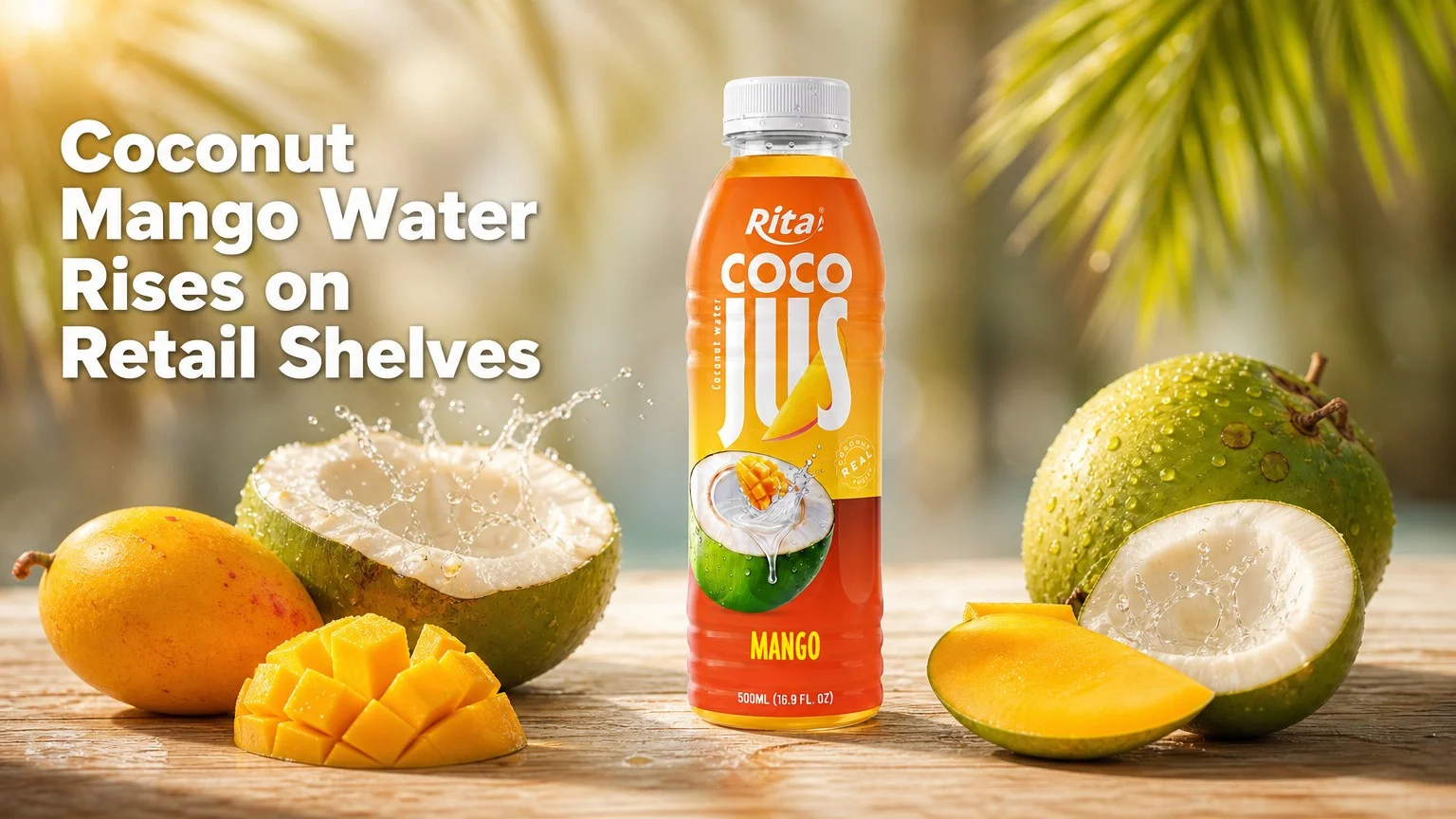
COCO JUS ticks each of those boxes with an orange-gradient label, a green coconut illustration and bold mango-yellow lettering, wrapped around a transparent PET bottle that shows the yellow-orange liquid inside. From a merchandising standpoint, the shelf presence does a significant amount of the selling work before the shopper even lifts the bottle.
Inside The COCO JUS Coconut Water With Mango Juice Formula
Behind the shelf presence sits a formulation designed for consistency across large production runs and long distribution chains. The blend centres on coconut water drawn from mature coconuts, combined with real mango juice, and supported by water, sugar, citric acid, mango flavour, ascorbic acid, preservatives, sucralose and colour. The result is a light, tropical drink that keeps its brightness without leaning into heavy sweetness — an important distinction in a category where artificial flavouring is often easy to detect. The technical parameters are equally deliberate. A Brix level of 7.0 ± 0.5 delivers naturally light sweetness, while a neutral pH of 4.0 ± 0.5 supports product stability across the shelf life. On a 500ml serving, the nutrition panel reports 140 kcal, zero fat and 35 g of carbohydrate, of which 32.5 g are sugars, alongside 560 mg of potassium and calcium and magnesium minerals. For buyers building ranges for ingredient-conscious shoppers, that level of specification detail makes range planning far easier.
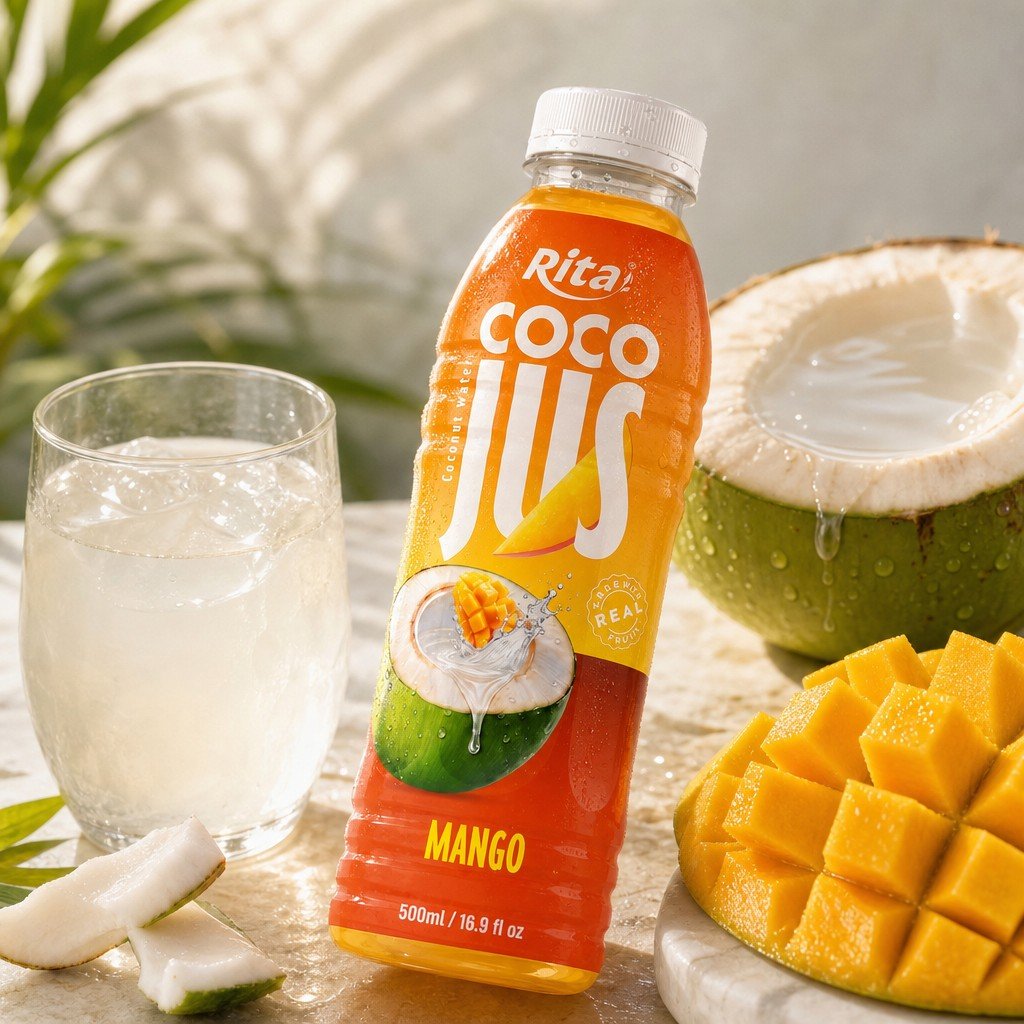
Flavour architecture matters as much as the numbers. The coconut element carries the drink, while the mango layer supplies the aromatic top note and the characteristic golden colour. Rather than masking the base, the mango accentuates it, which is why the product appeals to shoppers who want something tropical without the cloying profile of a full-strength fruit nectar. UK retailers who have trialled similar blends report that this balance performs well in both ambient chillers and standard shelf bays.
For buyers exploring alternatives, the broader COCO JUS lineup sits within a wider catalogue of tropical and coconut-based beverages available at our coconut water collection, with complementary juice formats documented across the fruit juice range. That range depth matters when a buyer wants to build a coordinated tropical set rather than a single SKU.
From Orchards To Bottles, Sourcing The Raw Materials
Sourcing is where beverage export credibility is won or lost, and the raw material base for this blend is drawn from two of Southeast Asia's most established growing regions.
Coconut supply for the range is anchored in Vietnam's coconut heartland, where the Ben Tre coconut farm programme traces the journey from plantation through to high-quality finished products, giving buyers visibility into the origin of the water that forms the base of every bottle.
The mango component follows a parallel trail. The mango farm-to-bottle story documents how fruit is selected at peak ripeness and moved into juice production, preserving the aromatic character that gives the COCO JUS blend its recognisable tropical profile.
For a visual walkthrough of that raw material journey, the coconut farm footage below shows the scale and conditions behind the sourcing programme that feeds this category of beverages: https://www.youtube.com/watch?v=I7hlTL3FT_0
Origin transparency is becoming a commercial asset rather than a nice-to-have. UK buyers increasingly ask where a tropical base is sourced, how that supply is managed and whether the manufacturer can demonstrate traceability end to end. Brands that can answer those questions in the first meeting tend to move through retail evaluation far faster.
Export Capacity And The Trade Case For Tropical Listings
Scale is the part of the conversation that separates a promising sample from a dependable listing. RITA Food and Drink Co., Ltd operates more than 50 automated production lines and ships over 1,200 containers per month, supported by advanced research and development and a quality system built around globally recognised certifications including BRC, FSSC 22000, Halal Jakim, Halal HCA-GCC, Kosher, ISO, GMP, HACCP and SMETA. That infrastructure is what allows a manufacturer to serve large retail programmes without asking buyers to absorb production risk. For UK importers and distributors, that combination of volume and certification coverage removes several of the usual friction points. Product is produced under strict international quality standards, packaged across PET, PP, glass and aluminium formats depending on the programme, and supported by a documentation trail that retail compliance teams typically expect before a first order is placed. The result is a supplier conversation that starts with specifications and logistics rather than feasibility questions.
Private Label Opportunities For UK Brands And Distributors
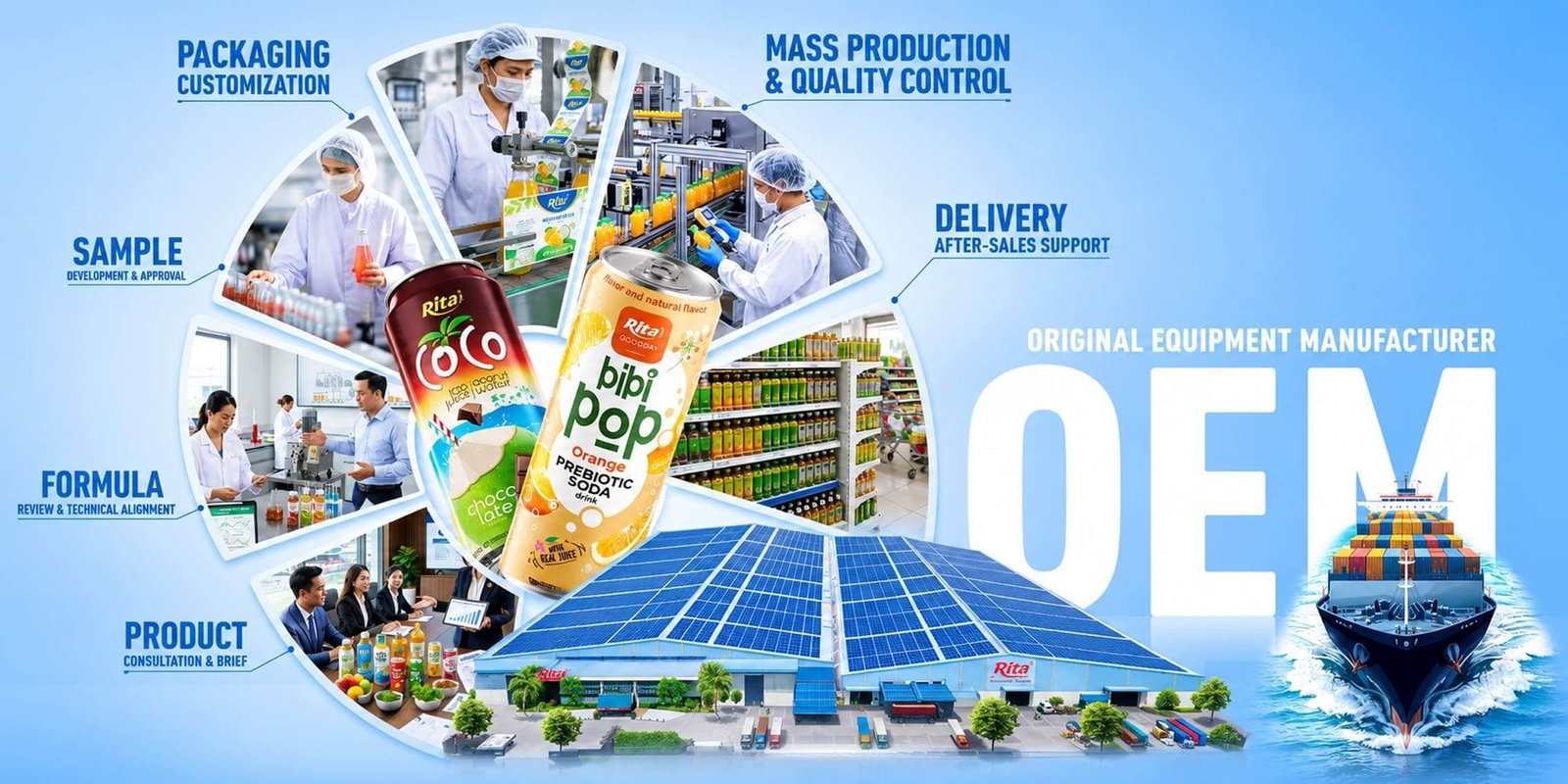
Perhaps the most commercially interesting angle for the British market is the private label route. RITA offers comprehensive OEM services alongside ODM development, allowing UK-based brands and distributors to commission their own formulations, packaging formats and branding on top of established manufacturing infrastructure and quality assurance systems.
That means a distributor evaluating COCO JUS Real Coconut Water with Mango Juice can do so in two ways. The branded route provides an export-ready SKU with an existing visual identity, realistic shelf pricing and no development lead time. The private label route lets a buyer differentiate on flavour, format or brand story while still working with the same production lines, certification suite and raw material supply chain. For buyers who are weighing the two options, the trade-off is usually straightforward. Branded stock shortens time to shelf and carries established recognition among category-aware buyers. Private label programmes deliver better margin control and brand ownership, at the cost of a longer development window. RITA's model supports both, which is one reason the manufacturer now works with channels in more than 200 countries and territories.
Shelf Life, Logistics And Retail Readiness
Practical logistics decide whether a tropical listing survives its first season in UK warehousing, and COCO JUS has been specified with that reality in mind. The product carries an 18-month shelf life when stored under cool, dry conditions, giving buyers comfortable buffer for forward buying, seasonal promotions and long-haul replenishment.
Delivery lead times typically run at 20–25 days after order confirmation, a window that import planning teams can schedule around without the volatility that sometimes affects smaller suppliers. The PET bottle format adds its own advantages: lighter than glass for freight, resistant to breakage in transit and compatible with the shelf-stable distribution model that most UK grocery networks operate on. For range planners, the practical checklist looks like this:
- Confirm shelf life against planned promotional windows — 18 months provides ample cover.
- Validate certification documentation for BRC, FSSC 22000, Halal Jakim, Kosher, ISO, GMP, HACCP and SMETA before first shipment.
- Plan pallet configurations and container loading around 500ml PET units.
- Agree whether the route is branded COCO JUS or a private label programme using the same base formulation.
- Map complementary SKUs from the coconut water catalogue to build a cohesive tropical set.
With those steps in place, a coconut water with mango juice listing moves from concept to a fully documented, export-ready commercial decision.