RITA on Alibaba





The global non-alcoholic beverage aisle has become one of the most competitive corners of FMCG retail, and flavour differentiation increasingly determines which products earn shelf space.
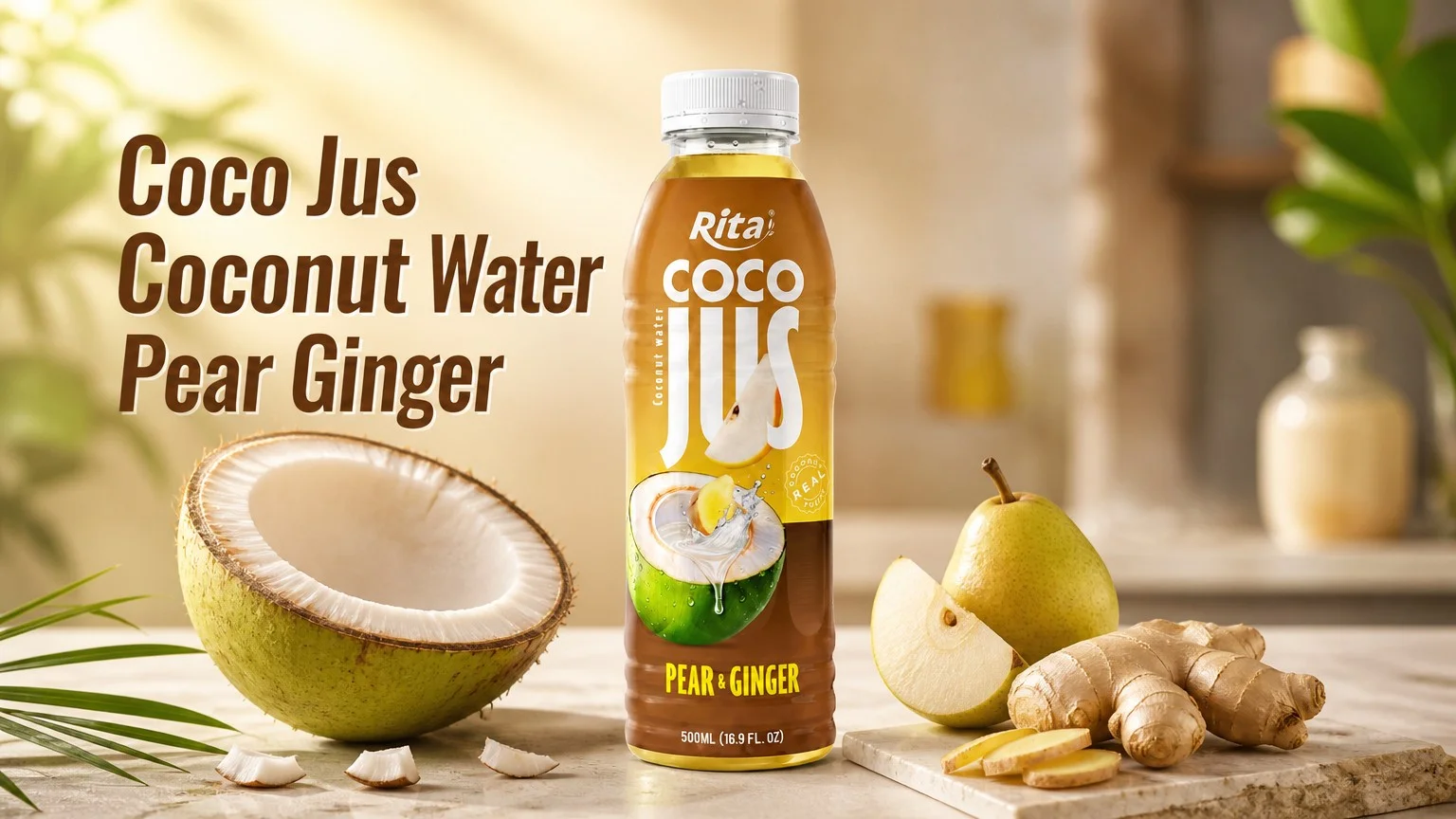
A closer look at Coco Jus Real Coconut Water with Pear and Ginger — a 500ml (16.9 fl oz) PET bottle manufactured by RITA Food and Drink Co., Ltd — shows how one carefully balanced blend can serve both retail shelves and private label programmes at the same time. The drink combines authentic coconut water, fresh pear and ginger into a light, golden-hued juice calibrated to a 7.0±0.5 Brix level, producing a sweet-and-spicy profile that sits distinctly apart from standard coconut water offerings.
Key Takeaways
- Coco Jus Real Coconut Water with Pear and Ginger Juice is supplied in a 500ml (16.9 fl oz) PET bottle, a practical format for chilled retail, foodservice and on-the-go consumption.
- Real coconut water, pear and ginger are blended at a controlled 7.0±0.5 Brix specification, delivering a balanced sweet-and-spicy taste experience.
- RITA Food and Drink Co., Ltd, established in 2004, runs more than 50 automated production lines and exports to over 200 countries and territories.
- The product carries a comprehensive certification portfolio including BRC, FSSC 22000, Halal, Kosher, ISO, GMP and HACCP.
- An 18-month shelf life, combined with private label flexibility, makes the SKU attractive to UK distributors, importers and retail brand owners.
Brand Spotlight — Coco Jus Real Coconut Water with Pear and Ginger on the UK Market
For buyers across England, Scotland, Wales and Northern Ireland, the question in this category is rarely whether coconut water sells — it is which format and flavour story earns repeat purchase in a crowded aisle. The Coco Jus range answers with a product whose on-shelf presence signals what the drink contains before it is even tasted: bold COCO JUS lettering, a cracked green coconut image with a splash of pear and ginger, and a clear REAL FRUIT badge set against brown, yellow and green tones on a transparent bottle with a clean white cap.
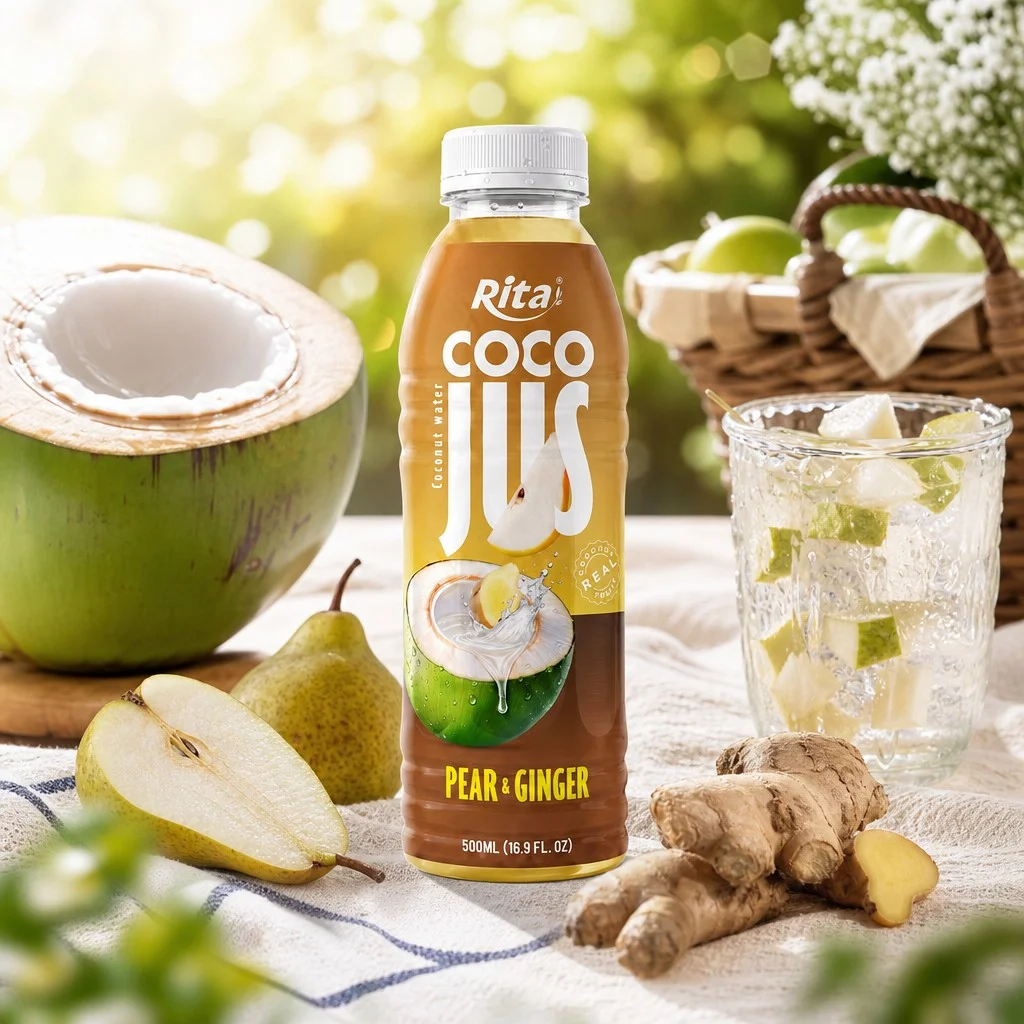
The pale golden liquid visible through the PET bottle is a deliberate part of the design language. Rather than hiding the beverage behind opaque packaging, the format lets the colour, clarity and light texture of the juice do the visual work — an approach that aligns with the preference among younger shoppers for drinks that look clean and unadulterated when opened. For retail buyers comparing facings, that visual honesty matters as much as the flavour specification. Retail decision-makers also tend to weigh format carefully. A 500ml (16.9 fl oz) bottle occupies a familiar sweet spot: large enough to satisfy a single-serve occasion, light enough to travel, and economical to merchandise alongside standard PET beverages. That balance helps the product sit comfortably in chiller cabinets, meal-deal displays and impulse fixtures without demanding a premium shelf planogram from the retailer.
Flavour, Brix Level and Bottle Format
The core of the product lies in the way three ingredients are layered rather than simply mixed. Real coconut water provides a light, slightly nutty base with a clean finish; fresh pear adds rounded sweetness and a gentle aroma; ginger introduces a warm, spicy edge that keeps the drink from reading as another plain coconut offering. The result is a beverage that moves between sweetness and spice without any one note overwhelming the others. Brix control is what makes that balance repeatable across production batches. The product is specified at 7.0±0.5 Brix, a level that sits between a lightly sweetened coconut water and a full-strength fruit juice. For importers and retail buyers, that specification matters commercially as well as sensorially — it defines how the drink tastes in the bottle, how it behaves on shelf, and how consistent each pallet will be once it arrives. The 500ml PET bottle itself is engineered around portability and durability. PET keeps the bottle lightweight for shipping and retail handling, holds shape under stacking, and remains widely recyclable across UK waste streams — a practical consideration for national retailers managing packaging targets.
| Specification | Coco Jus Pear & Ginger | Typical Coconut Water |
|---|---|---|
| Volume | 500ml (16.9 fl oz) | 330ml – 1000ml PET |
| Brix level | 7.0±0.5 | 4.0 – 6.5 Brix |
| Key ingredients | Coconut water, pear, ginger | Coconut water |
| Appearance | Light golden hue | Clear to slightly cloudy |
| Shelf life | 18 months | 12 – 24 months |
| Packaging | PET bottle, white cap | PET, glass or can |
| Certifications | BRC, FSSC 22000, ISO, GMP, HACCP, Halal, Kosher | Varies by supplier |
Certification and Quality Assurance
The product's compliance footprint is unusually broad for a single SKU in this segment. It is produced under BRC, FSSC 22000, ISO, GMP and HACCP frameworks, with Halal Jakim, Halal HCA-GCC and Kosher certification also in place. For UK retailers and wholesalers, that combination reduces the documentation burden at onboarding and simplifies supplier approval processes that often stretch for months. That certification depth reflects the scale of the manufacturer behind the product. RITA Food and Drink Co., Ltd was established in 2004 and today operates more than 50 automated production lines, exporting over 1,200 containers monthly to buyers in more than 200 countries and territories. For the full specification, packaging options and certification documents, the Coco Jus Real Coconut Water with Pear and Ginger Juice 500ml product page provides the definitive reference.
From Our Orchards — Sourcing the Coconut Water, Pear and Ginger
Traceability has moved from a nice-to-have to a commercial expectation in the beverage trade. Behind the blend stands a raw material base that suppliers and importers are increasingly keen to understand. RITA's coconut supply originates from established growing regions in Vietnam, where long cultivation experience and tropical growing conditions combine to produce consistent raw material quality batch after batch. Those origins are documented publicly rather than left to marketing claims, giving buyers something concrete to reference during supplier evaluation. The company's Ben Tre coconut farm documentation traces the journey from plantation to finished coconut water, covering how raw material is handled, graded and prepared before it enters the production stream. It is exactly the kind of supplier-level evidence that category buyers in the UK now request during due diligence. Alongside the coconut base, the pear and ginger components are sourced through the wider sourcing network that RITA maintains across the Mekong Delta raw material region, an area recognised for its diversity of fruit crops and established agricultural infrastructure. The result is a supply chain that can hold specification over time rather than only during a single harvest window. For a visual look at the growing environment behind these raw materials, RITA's plantation footage can be viewed at https://www.youtube.com/watch?v=I7hlTL3FT_0
From Farm to Finished Blend
The route from raw material to bottled product is where consistency is won or lost. Ingredient handling, temperature control, filtration and blend calibration all influence whether the 7.0±0.5 Brix specification holds across a production run, and whether the flavour profile the retail buyer approved in sampling is the profile that arrives in the warehouse. RITA's approach centres on controlled production at scale rather than small-batch variability. The company manufactures across aluminium cans, glass bottles, PET and PP formats, which means each pack format can be specified around the beverage's own requirements instead of forcing the beverage to suit the packaging. This matters commercially in the UK, where distributor margins and shelf turnover both depend on product arriving in a condition that matches the approved sample. Consistency across shipments is one of the quietest but most valuable attributes a supplier can offer a national retail account.
What Coconut Water with Pear and Ginger Brings to UK Retail Shelves
The competitive reality of the UK chilled aisle is simple — a new flavour has to justify its facings within weeks, not months. Several positioning cues work in the product's favour. The blend sits outside the crowded pure coconut water segment and outside the equally busy mainstream fruit juice aisle, occupying a hybrid space that consumers increasingly discover through variety-seeking rather than established habit. The pear and ginger combination also gives retailers an easy talking point for merchandising, since neither ingredient is overfamiliar in this format.
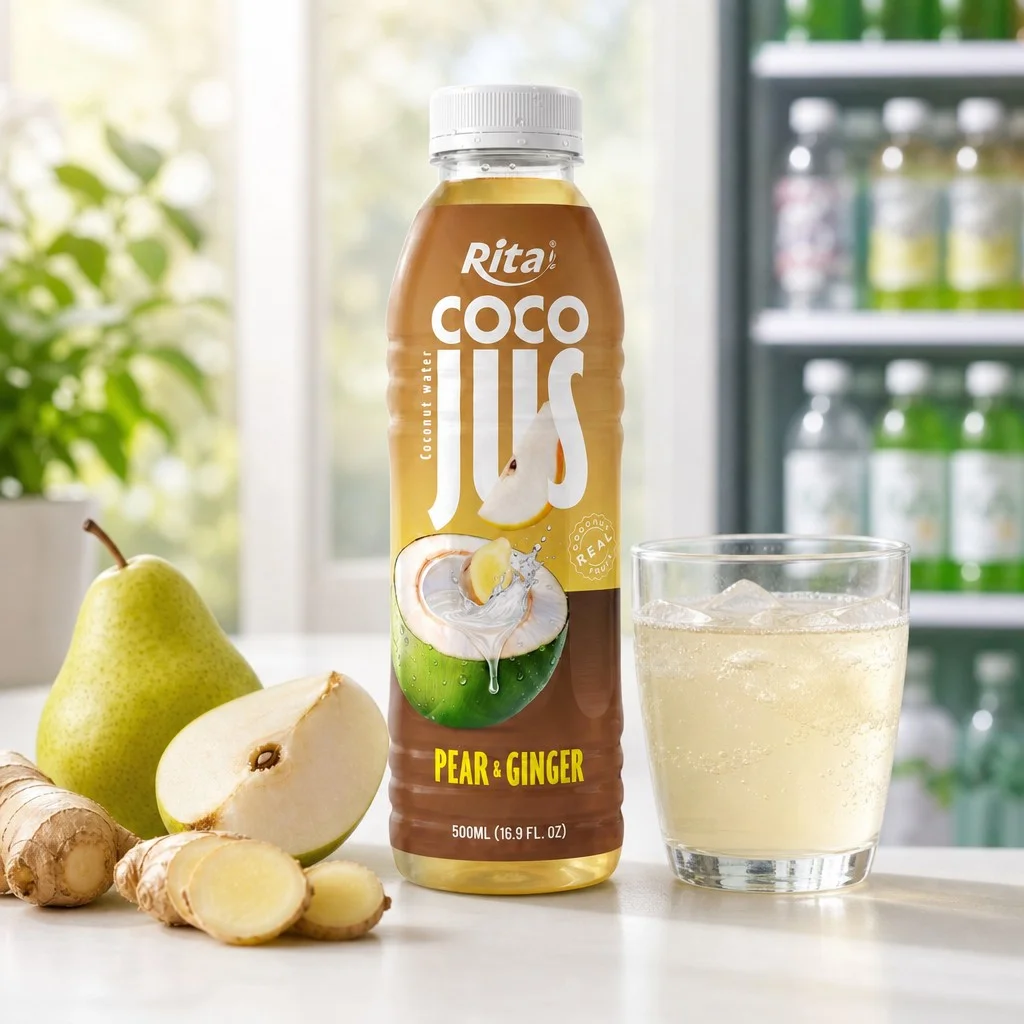
Beyond flavour novelty, the product benefits from format practicality. Chilled PET beverages continue to grow their share of the impulse and on-the-go occasion, and a 500ml bottle that fits the category convention while offering a more distinctive taste profile gives buyers a straightforward reason to trial it. As the coconut water product catalogue shows, the wider category now spans far more than plain coconut water, and buyers are actively selecting across that range.
Flavour Positioning for the UK Chilled Aisle
Category analysts have long noted that tropical blends travel well into the UK market, particularly when they are anchored to a familiar base and topped with a recognisable secondary flavour. In this case the coconut water provides the anchor, while pear and ginger provide the differentiation retail buyers are looking for when refreshing a range. The sweet-and-spicy profile also opens more than one consumption occasion. It can sit naturally alongside lunchtime meal deals, afternoon refreshment or evening dining formats, giving retailers flexibility in where the product is merchandised rather than forcing it into a single fixture.
- Range extension: a direct fit for retailers expanding beyond plain coconut water without launching an entirely new brand family.
- Flavour storytelling: a clear, easily merchandised narrative around three recognisable ingredients.
- Format credibility: a 500ml PET bottle aligned with established chilled beverage conventions.
- Spec confidence: an 18-month shelf life with documented Brix and certification standards behind it.
Private Label and OEM Beverage Manufacturing with RITA
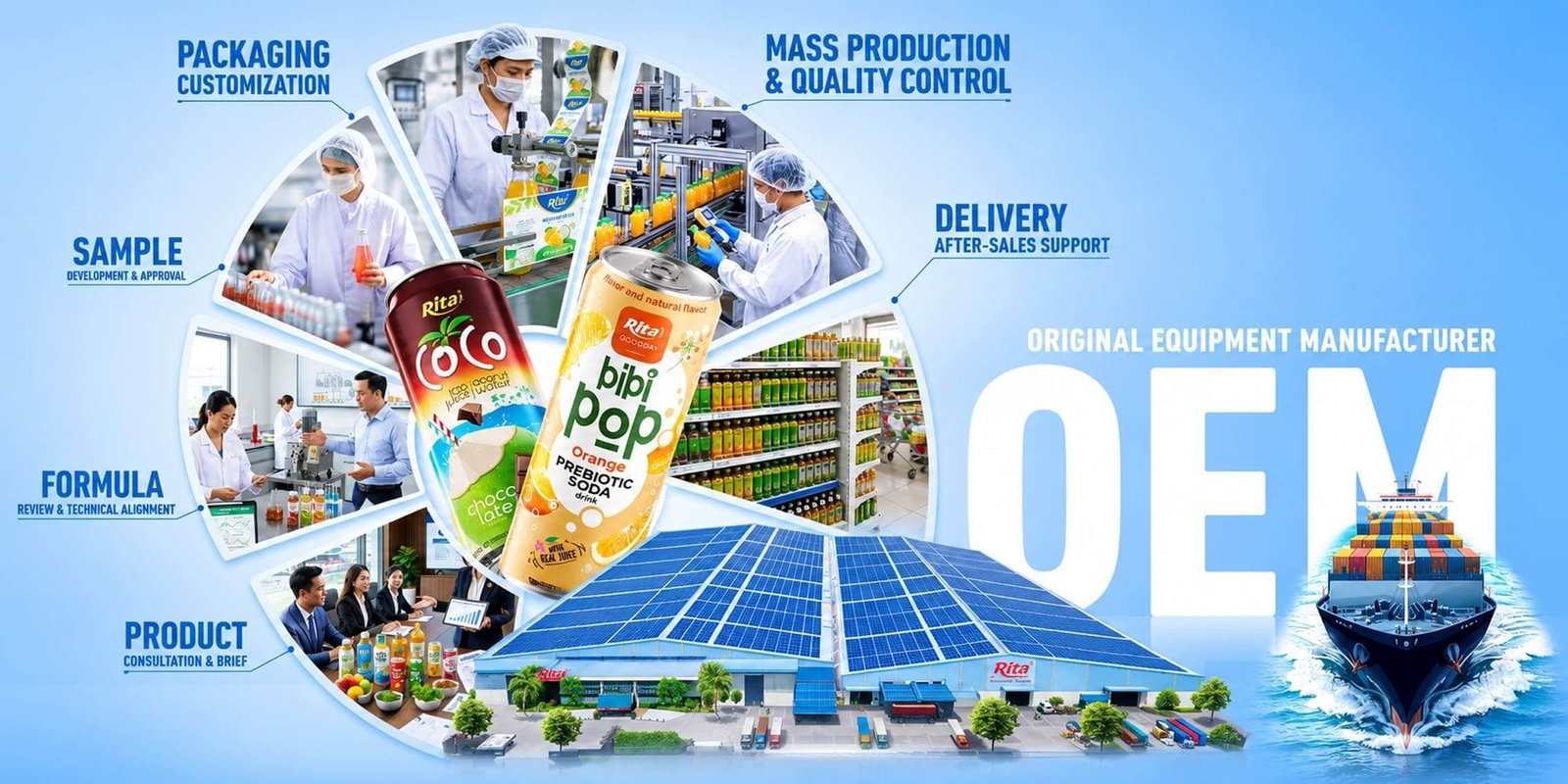
For brand owners, the more interesting story behind this product is not only what it tastes like — it is what the manufacturer can build around it. RITA works as an OEM ODM beverage supplier for buyers who need more than a stock product. Formulations can be adjusted to local taste preferences, packaging can be redesigned for a specific retail audience, and branding can be developed around a retailer's own range strategy. For distributors considering how to expand a portfolio without building manufacturing capability from scratch, that is the value proposition that matters most. The scale of the operation behind that flexibility is substantial. With 50+ automated production lines, an in-house research and development capability, and more than 1,200 containers exported every month, RITA combines the agility of a Vietnamese manufacturer with the compliance infrastructure that UK and European buyers expect. Additional detail on the company's manufacturing footprint is available through the OEM beverage manufacturing service overview.
Private Label Flexibility
Private label demand has grown across UK retail in recent years, driven by consumer willingness to switch from established brands to retailer-owned ranges when quality and price align. That shift rewards manufacturers who can move quickly between stock formulations and bespoke ones. The Coco Jus Real Coconut Water with Pear and Ginger Juice listing demonstrates how an existing, fully specified product can serve as a reference formulation — a starting point that brand owners can adapt in flavour, sweetness, volume or pack format while keeping the quality framework already in place. Packaging options extend well beyond this single bottle. The company supplies aluminium cans, glass bottles, PET and PP formats, giving private label clients the choice of pack format that best suits their retail channel rather than being limited by an existing template.
Market Outlook for Coconut Water Beverages
Category momentum is broadly positive, but the direction of growth is shifting from raw volume toward flavour, format and brand experience. Industry commentary this year has reinforced several of those shifts. Keurig Dr Pepper appointed a new head of its coffee business and launched global cold-coffee concentrates to capitalise on the continuing rise of chilled coffee occasions a reminder that even established categories are being redrawn around how and where drinks are consumed. In the wider wellness-adjacent beverage space, Cizzle Brands identified substantial growth potential in the sports drinks segment as consumers look for products positioned with clearer formulation stories. Marketing practice is evolving alongside product development. Benchmark Drinks' managing director has urged wine brands to prioritise emotional storytelling over technical jargon, a principle that applies equally to non-alcoholic beverages where flavour description is often the primary route to trial. Meanwhile, Amber Latvijas Balzams has continued to report weak volumes as it works through a difficult period, underlining the risk for any category player that fails to refresh its range. Against that backdrop, a fully specified, certifiable and flavour-differentiated product such as Coco Jus Real Coconut Water with Pear and Ginger carries a clear commercial advantage. It gives buyers something to merchandise with confidence — a defined taste story, a credible specification, a recognised pack format and a supplier with demonstrated export scale.